
Installing Storage Rack for Automated Warehouses
Installation Considerations for Integrating Rack with Warehouse Automation
As we discussed in Part 1, Planning Storage Rack for Automated Warehouses, a well-planned storage system helps create the foundation for a successful automation project. Once the storage strategy is set, attention turns to installation and the details that help ensure the rack and automated equipment work together as intended.
Installation accuracy is especially important when storage rack interfaces with conveyors, robots, AGVs, AMRs, and other automated material-handling equipment. These systems rely on consistent positioning, clearances, elevations, and properly installed rack to support reliable inventory movement.
In Part 2, we’ll look at the installation considerations that matter when integrating storage rack with warehouse automation, including rack and conveyor integration, automated equipment interfaces, lift-off clearances, pallet positioning, installation tolerances, and project sequencing.
Automation Requires Installation Precision
Storage racks have to be installed accurately to support automated workflows. When a machine puts a pallet away, it repeats the same motion every time and expects the rack to be where the drawings say it is.
That puts five things front and center:
-
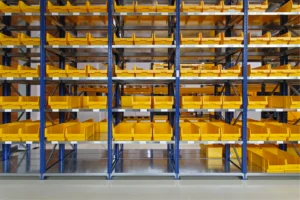
Rack alignment: Frames set on line, bay to bay, and row to row, so equipment sees a consistent target
- Elevation consistency: Beam levels matched across the run, not just within a single bay
- Level installation: Shimming as required so base plates sit flat and loads transfer evenly
- Plumb and square construction: Uprights installed plumb and frames square in both the down-aisle and cross-aisle directions
- Following engineered drawings and installation requirements: The final approved drawings establish the rack layout, elevations, dimensions, and other critical requirements installers need to follow. Anchoring, hardware, beam locks, and connections should also be installed to the manufacturer’s specifications and the approved drawings
If you’ve ever specified very narrow aisle rack, the logic will feel familiar. Tight equipment tolerances raise the cost of a small mistake. Small installation variances that may have little impact in conventional storage can become significant when inventory is transferred automatically.
Rack and Conveyor Integration
Conveyors are like the connective tissue in an automated warehouse. It moves pallets between receiving, storage, production, and shipping. At some point, it has to hand that load off to (or take it from) the storage rack system.
Those handoff points deserve attention during installation:
-
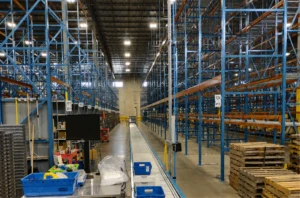
Conveyor transfer locations: Where pallets enter and exit the rack area, and whether the surrounding structure leaves room for them
- Powered conveyor sections: Powered conveyor at rack interface points requires proper clearance, alignment, and access for components and service
- Consistent transfer elevations: Deck heights and beam elevations that line up so a load moves across without lifting, dropping, or hanging up
- Coordinating rack and conveyor installation: One layout, one set of dimensions, and one crew sequence rather than two trades working from separate assumptions
- Maintaining access for maintenance and service: Motors, controls, and jam-clearing points that stay reachable after the rack goes in
Get the interface right during installation, and the two systems behave as one.
Planning for Automated Equipment Interfaces
Automated equipment needs a predictable place to pick from and set down. Those locations should be identified before installation, not discovered during commissioning:
- AGV interface locations: Designated rack positions where vehicles pick up or deposit pallet loads
- AMR pickup and drop-off points: Designated locations that provide the access and clearances required for automated load transfer
- Robotic pallet pickup locations: Bays or floor positions dedicated to automated retrieval
- Inventory transfer points: Where a load changes hands between systems, equipment, or people
Three installation-side factors carry most of the weight here:
- Clear access. Approach paths, turning space, and vertical clearance need to stay open. Frames, posts, guarding, and column protection all belong in that conversation early.
- Consistent pallet presentation. Automated equipment expects loads to sit the same way every time: same height, same setback, same orientation. Rack that’s installed at a consistent elevation makes that far easier to achieve.
- Coordinating rack layout with equipment requirements. AGVs and AMRs have different navigation and clearance needs. Rack layout and installation should account for the specific equipment that will interact with the storage system.
Rack Protection and Critical Layout Dimensions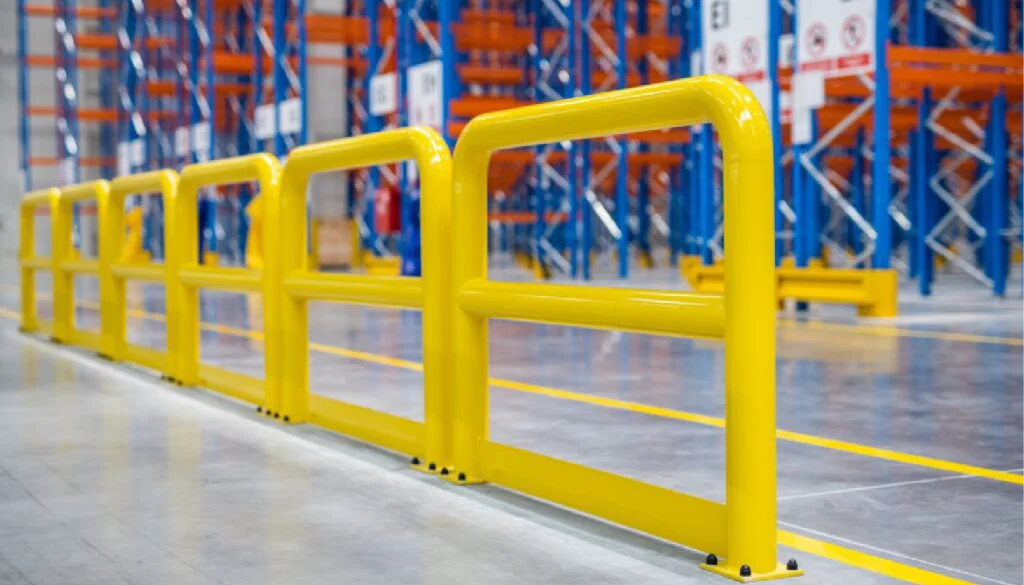
Rack protection is an important safety consideration, but it also occupies physical space around the storage system. In an automated warehouse, column guards, end-of-aisle protection, guardrails, and other protective components should be accounted for in the layout rather than added after critical equipment clearances have been established.
Consider how rack protection may affect:
- Aisle and equipment clearances: Protective components should fit within the planned layout without interfering with required operating space.
- AGV and AMR travel paths: Guarding and rack protection should be positioned with the equipment’s travel and approach requirements in mind.
- Pickup, drop-off, and transfer locations: Protection should not interfere with the access that automated equipment needs to transfer loads.
- Rack and conveyor interfaces: Guarding near transfer points should be coordinated with conveyor locations, clearances, and service access.
- Final layout dimensions: The footprint and placement of rack protection should be reflected in the approved layout so that installers work from the complete system design.
- Guardrail barrier to prevent unauthorized personnel and PIV from entering the rack area.
Accounting for rack protection early helps preserve the critical dimensions established for both the storage rack and the automated equipment operating around it.
Lift-Off Clearance and Pallet Positioning
Lift-off clearance is the vertical space a load needs to be raised off the beams before it can be pulled out of the bay. In a manually operated warehouse, an operator can see the available clearance and adjust. Automated equipment, however, relies on predetermined movements and consistent positioning.
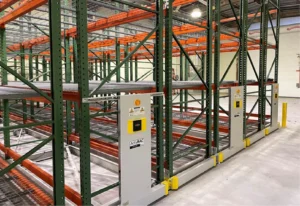
That makes a few conceptual points worth planning around:
- Why lift-off clearance matters: Too little clearance and the load drags, snags, or trips a fault; too much and you give up usable vertical space.
- Proper pallet positioning: Loads set at a consistent depth in the bay so the next automated pick starts from a known position.
- Pallet back stops: Pallet stops can help establish consistent load positioning by preventing pallets from being placed too far into the rack.
- Maintaining repeatable pallet placement: Every load lands where the system expects it, every cycle.
Coordinating the Installation Process
Automation projects involve several installations happening in the same building, usually on overlapping schedules.
A typical project touches:
- Rack installation
- Conveyor installation
- Electrical work
- Controls and integration
- Safety systems, guarding, and barriers
Which is why the coordination matters as much as the craft:
- Installation sequencing: Coordinating when rack, conveyor, controls, and safety systems are installed so each phase is completed in the proper order.
- Communication: One point of accountability across trades instead of a chain of handoffs
- Scheduling: Work planned around shifts, deliveries, and production windows
- Minimizing disruption in active facilities: Staged areas, protected traffic lanes, and clean work zones so the operation keeps running
WOI works as a licensed general contractor, so installation, electrical, permitting, and scheduling can be managed under a single scope rather than divided among vendors, each owning a piece of the outcome.
Safety Starts with the Installation Team
Safe rack installation requires more than the right equipment and an approved layout. The experience and qualifications of the installation crew matter, particularly on automated warehouse projects where multiple systems and trades may be working within the same facility.
Experienced, insured, licensed, vetted installation crews understand how to work from approved drawings, follow manufacturer installation requirements, recognize jobsite hazards, and coordinate their work safely around other contractors and active warehouse operations.
Installation safety considerations include:
- Qualified project managers and trained installation crews
- Daily jobsite safety reviews and inspections
- Authorized and trained lift equipment operators
- Clearly defined work and traffic areas
- Coordination with other trades working in the facility
- Following approved drawings and installation requirements
- Large project references
Selecting an experienced installation team helps support both job-site safety and accurate project execution.
WOI Professional Installation
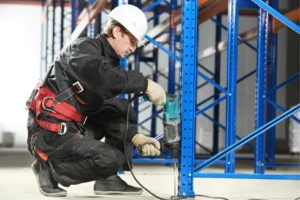
Proper installation helps ensure the storage infrastructure is ready to support the automated systems it was designed to work with. At Warehouse Optimizers, Inc. (WOI), safety, accuracy, and attention to detail are priorities on every project.
With more than 300 installations completed annually, our experienced, vetted installation team manages projects from permitting through final sign-off to help deliver safe, efficient, and professionally executed installations.
WOI Professional Installation:
- OSHA-10 Trained Project Managers
- Drug-Free Workplace Certification
- Daily Job Safety Analysis and Jobsite Inspection
- Authorized and Trained Forklift, Scissor Lift, and Aerial Lift Operators
- TN & AL Licensed General Contractor #00046536 ($1M License)
- Insurance Experience Mod. Rate 1.0
- Full Insurance with a $5M Umbrella
Build the Foundation Your Automation Depends On
Warehouse automation depends on more than advanced equipment. Storage rack that interfaces with automated material handling equipment has to be installed with the same attention to detail as every other component in the system. Careful planning, accurate installation, and coordination throughout the project help create an operation that performs reliably for years to come.
When you partner with WOI, you gain a dedicated team committed to your success. Our WOI Total Satisfaction Experience™ is built around five key principles:
- Listening to Your Needs – We start with how your automation actually operates: what equipment interfaces with the rack, where loads transfer, and what your throughput targets require.
- Executing with Precision – Our crews install according to the approved drawings and manufacturer specifications, with attention to the alignment, elevation, and plumb tolerances automated equipment depends on.
- Adhering to Timelines – We carefully plan and coordinate installation activities around the project schedule to keep work moving efficiently.
- Ensuring Safety – OSHA-10-trained project managers and daily job safety analyses keep the jobsite safe while your facility stays in operation.
- Attention to Detail – Anchors, beam locks, shims, clearances, and transfer points get checked before signoff, because the small things are what automated systems find first.
Improve warehouse efficiency and safety with WOI’s professional storage rack installation services. Call (865) 540-4004 or contact our team to discuss your next automated warehouse project.
WOI Service Areas
Nashville TN, Knoxville TN, Clarksville TN, Memphis TN, Chattanooga TN, Johnson City TN, Huntsville AL, Birmingham AL, Bowling Green KY, Asheville NC, Charlotte NC, Kalamazoo MI, South Bend IN
Contact Us Today
We will be happy to assist you with any questions or more detailed product information on any Warehouse Optimizers products.