
WOI Risk Rewards Series – Pallet Flow Racking
Risky Business Should Not Include Your Pallet Flow Rack – See Our Rack Safety Tips
“Just go with the flow” isn’t the typical mantra in a busy warehouse, but in this case, it’s a great idea. Pallet flow rack is a popular pallet storage rack system that delivers many benefits and can be used in various ways to improve inventory storage and processing.
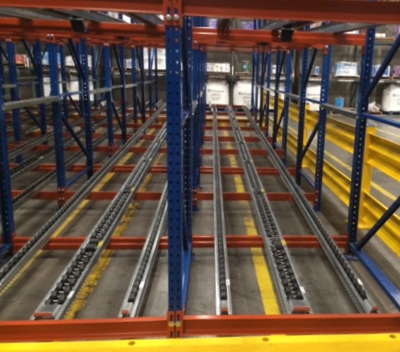 Pallet Flow Rack Applications
- High-Volume FIFO Pallet Storage Rack
- Deep-Lane LIFO Pallet Storage
- Case Picking from Pallet Flow Rack
- Pallet Staging – Pallet Flow Rack Has You Coming & Going
High-Volume FIFO Pallet Storage Rack
Pallet flow rack is most often used for full pallet storage of high-volume SKUs. The system design relies on lanes of wheels or rollers set into a condensed rack configuration. The flow rails are pitched to automatically flow pallets from the loading aisle to the pick aisle. SKUs are stored separately in each lane for quick, accurate selection, and the lanes can go up to 10 pallets deep. Systems with multiple levels provide high-density storage in a small footprint maximizing warehouse cube space.
Deep-Lane LIFO Pallet Storage
Pallet flow rack can also provide LIFO storage as a push-back flow rack application. This configuration uses a single-aisle for loading and unloading. It is more flexible than a traditional push-back cart system for pallets of varying sizes or unusual shapes. It is also lower profile than a push-back cart system, possibly allowing more levels of storage.
Case Picking from Pallet Flow Rack
Another option for pallet flow is a floor-mounted case pick application. You can use this setup for manual case picking or robotic arms and layer pick attachments for mixed pallet building. Pallets are loaded into flow lanes that feed automatically to a pick aisle. The deep lane storage and loading from an opposite aisle increases pick rates by allowing picking to continue uninterrupted.
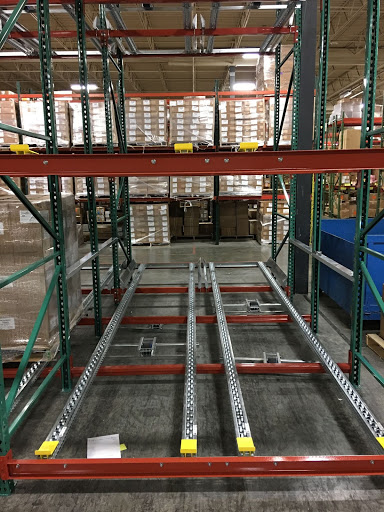 Pallet Staging – Pallet Flow Rack Has You Coming & Going
Using gravity flow rack for incoming or outgoing pallets is a productive way to improve dock efficiency and keep inventory neatly organized. Three things, in particular, are at play at your dock – 1- safety, 2 – accuracy, and 3 – speed. Using pallet flow, you can organize pallets lanes dedicated to storage areas, dock numbers, shift work, etc. — configure the lanes as you need to keep your team safe and keep inventory flowing.
Pallet Flow Rack Rewards
- Dense pallet storage – FIFO or LIFO configuration
- Individual SKU lanes – accurate picking
- Ideal for high-volume SKUs – 2 to 10 pallets deep per lane
- Separate load & pick aisles decrease wait time & aisle congestion
- Low-maintenance & durable wheels or rollers
- No batteries required – simple to use and automatic pick face replenishment
Clearly, pallet flow is an excellent storage system for the proper application, but you may be wondering what the risks might be? Most risks of a pallet flow system have to do with improper system design and what you load into it.
Pallet Flow Rack “Risks”
- Loose dangling plastic wrap
- Broken, splintered, missing pallet boards,
- Softwood pallets
- System under-designed for load capacity
- Improper installation
Even Superman has kryptonite… loose, dangly plastic wrap and broken, soft pallets can disrupt your pallet flow lane enough to shut it down for repairs. In addition, it’s essential to configure your system for your pallets and pallet load weights. Overloading your pallet flow system can damage wheels and roller components, causing costly downtime and repair expenses. It is also critical to ensure an experienced crew installs your system. Uneven floors and out-of-plumb components will negatively affect the way your flow system operates.
The best way to ensure your pallet flow system will roll on for the long haul is to work with an experienced team to design and install it. You’re in luck; WOI is that kind of team.
Pallet Flow Rack Installation
Proper installation of pallet flow racking is critical to performance. Installation of the system should be square, level, and checked for plumbness. All pallets should be loaded and tested for proper flow before commissioning. Brake adjustment and placement may be necessary for proper safe flow. The WOI professional rack installation crew is OSHA-10 certified. To obtain that certification, each person must complete at least 10 hours of training and demonstrate an acceptable level of performance, competence, and professionalism. OSHA training includes safety guidelines, proper accident reporting, ladder safety, tie-off guidelines, PPE use, and general safe construction practices.
Before you hire your next installation crew, check out our tips of the 10 Most Valuable Questions to Ask.
Warehouse Optimizers, Inc. (WOI) has equipped warehouses and distribution centers for over twenty years with custom-configured material handling and storage solutions. Our long-standing reputation for excellence is backed up by our dedication to 100% customer satisfaction — we call it the Total Satisfaction Experience, and it is written into every design, drilled into every connection, and signed into every agreement.
5-Step Total Satisfaction Experience™.
WOI will:
- Listen to your needs
- Execute your project with special attention to your unique application
- Stick to project timelines
- Ensure a safe environment
- Pay close attention to the detail of the finished product
Call Warehouse Optimizers today, and let’s see if pallet flow rack is the right solution to your warehouse challenge. Call (865) 540-4004 for a prompt response. We proudly serve customers throughout the Southeast, including KENTUCKY, TENNESSEE, NORTH CAROLINA, ALABAMA, AND FLORIDA.
Contact Us Today
We will be happy to assist you with any questions or more detailed product information on any Warehouse Optimizers products.