
10 Tips for Pallet Rack Protection in Any Warehouse Environment
Prevent Costly Damage and Downtime – 10 Pallet Rack Protection Tips
You have a lot riding on the “health” of your pallet racking systems –literally and figuratively. Your rack is a structural element that protects your inventory, team members, equipment, and the productivity of your operation. Yet, your rack system can be left vulnerable to abuse from various avoidable circumstances. Follow these 10 tips to avoid unnecessary and costly downtime and the repercussions of damaged racking.
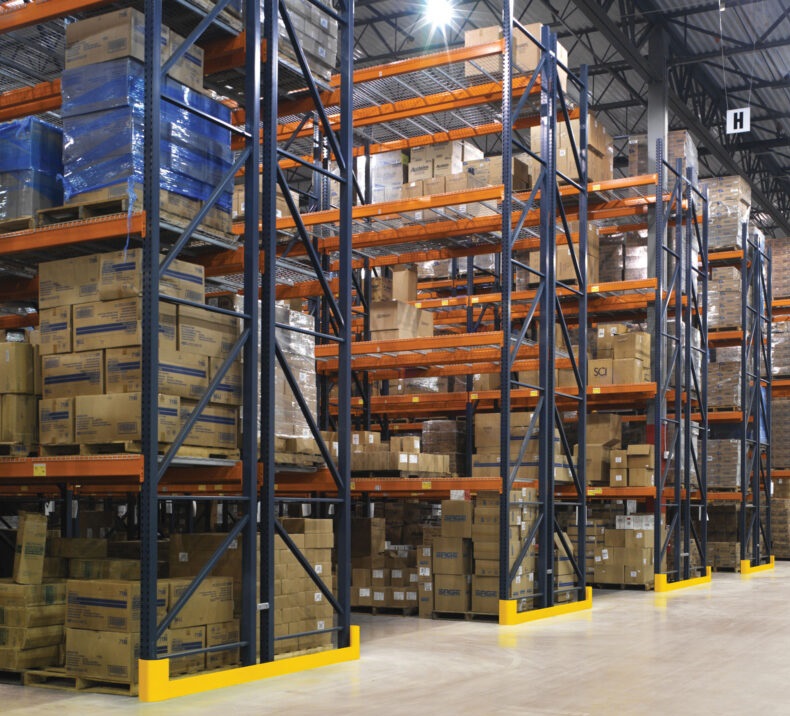 10 Tips to Pallet Rack Protection
- Custom-fit pallet rack to inventory specs
- Ensure enough aisle space
- Keep aisles clear
- Set speed limits & adhere to them
- Add pallet rack body armor
- Think bright
- Conduct regular inspections
- Require on-site operator training
- Paint your forks
- Create an open environment for reporting
1. Custom-fit pallet rack to inventory specs. This may seem obvious however a change in inventory or warehouse reconfiguration may leave you with pallets that are not right-sized for the racking system. For example, in a standard side-by-side bay formation, you must have 6” between the pallets and 5” on either side. In addition, you need 4″ – 6″ above the pallet load for safe lift-off. Pallets that are too wide, too tall, or too long pose a warehouse safety risk and damage to your rack structure, equipment, and personnel. It is also vital to ensure that your rack load capacities are adequate for your inventory. If your inventory changes or you reconfigure your rack, that must trigger an evaluation of the system load capacities to ensure it is up to the task.
2. Ensure enough aisle space. The forklift, lift truck, or pallet jack operator must have a safe turning radius to address the pallet rack system without bumping into it. Narrow aisle forklifts accommodate compact storage aisles, while larger vehicles should be expressly excluded from the area. Additionally, you can design pallet racking with a recessed front column to accommodate a wider forklift turning radius.
3. Keep aisles clear. Staging pallets or performing case loading can clutter aisleways. Consider shifts for loading and extraction and ensure that all debris –empty pallets, plastic wrap, cartons, etc. is completely removed from the aisle. Keep garbage cans nearby to make it easy for workers to keep the aisle clear. Establish a regular cleaning schedule as well.
4. Set speed limits & adhere to them. Train your forklift operators to know the restricted speed limits in your facility. Post easy-to-see signage and enforce a strict adherence policy.
5. Add pallet rack body armor. You wouldn’t go into battle without proper protection, so don’t ask your rack to do it. Since most pallet rack damage occurs on the lower 12” of the rack columns, it makes sense to add steel columns guards as pallet rack protection. End row guards wrap around the first column in the row and extend behind to protect the upright along the main aisleway.
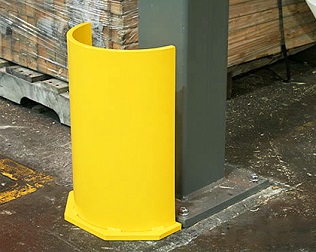 Column Protector |
 End Row Guards |
6. Think bright. The better your forklift and equipment operators can see, the better and more safely they can do their jobs. Lighting has come a long way in recent years with energy efficiency and brightness levels that can positively impact your operation. It’s worth taking a look at new options.
7. Conduct regular inspections. Schedule regular rack damage inspections. Depending on your warehouse activity, that can mean monthly or a few times a year. However, inspections are the best way to find potentially dangerous damage and areas of repeat damage that signal that something is amiss. Recognizing these areas and following up with rack repairs, better training, and or pallet rack protection pays you back in bottom-line savings.
8. Require on-site operator training. On-site training is OSHA compliant, so that alone is a reason to do it. Still, it also makes the most sense to ensure that your drivers are keenly aware of the particulars of your facility layout, potential risks, and warehouse safety regulations. Forklift operators must also stay current with certification renewals –every three to five years, depending on the equipment class.
9. Paint your forks. This is an interesting option for tracking damage and equipment misuse –or better yet, preventing it. By painting sets of forklift forks in different colors, you can easily identify who may have had a run-in with pallet racking or other pieces of equipment in your facility.
10. Create an open environment for reporting. Step one should be to train your entire team on warehouse safety. Drivers and pedestrians alike need to be given the tools and environment to do their jobs safely and an open path to report incidents. However, having a proactive response to understanding what led to the accident and then taking necessary steps to mitigate it from occurring again is the best way to stay ahead of the curve and protect your operation.
Could You Use a Single Source to Help Improve Warehouse Safety?
The steps laid out above are all actionable items that will improve safety in any type of industrial warehouse or distribution center. You may not need to apply all of them, but overall they are tried, true and effective. If you need help implementing your pallet rack protection, aisle-width designs, safety inspections, improved lighting and traffic flows, etc., you’ve got a partner in WOI that can get the job done.
The Warehouse Optimizers, Inc. team will meet with you to understand your concerns and challenges, and we will develop a plan to help you cost-effectively address them. Our seamless process keeps you and your satisfaction at the core; we even guarantee it.
WOI 5-Step Total Satisfaction Experience™
- We will listen to your needs
- Execute your project with particular attention to your unique application
- Stick to project timelines
- Ensure a safe environment
- Pay close attention to the detail of the finished product
Our professional installation crew completes over 300 rack installations per year with the goal of 100% customer satisfaction.
WOI Installation Team
- Industry Experienced Installation Teams
- OSHA Trained & Certified
- Certified Drug-Free Workplace
- Licensed General Contractor
- Job Safety Analysis
- Forklift, Scissor Lift, and Aerial Lift Operator Trained
Call today to schedule a free consultation and site inspection. Dial (865) 540-4004 or email info@warehouseoptimizers.com for prompt service. We proudly serve customers throughout the Southeast, including KENTUCKY, TENNESSEE, NORTH CAROLINA, ALABAMA, AND FLORIDA.
Contact Us Today
We will be happy to assist you with any questions or more detailed product information on any Warehouse Optimizers products.