
How About a Lift? An Overview of Vertical Reciprocating Conveyors vs. Freight Elevators
Vertical Reciprocating Conveyors & Freight Elevators — The Pinnacle of Vertical Efficiency
There is a trend in warehouse and distribution facility construction to go big with ceiling heights. In fact, it could be said that 36’ is the new 32’ when it comes to ceilings. Taller ceilings expand potential capacity, adding 10% – 25% more cube space. While vertical pallet rack systems are a popular way to maximize that higher elevation, so are industrial mezzanines. Mezzanines can be used for storage, order picking, personnel areas, equipment, and more. How you intend to use that space will also dictate the means for safely and efficiently transporting people and goods between the floor and mezzanine levels. Vertical Reciprocating Conveyors (VRCs) and traditional freight elevators are two of the primary systems employed for this purpose.
While VRCs are specifically designed for moving goods and materials—not humans—between floors in an industrial setting, freight elevators provide passenger and freight transport. Despite their shared function of vertical transportation, these systems differ in terms of design, capabilities, and appropriateness for specific tasks within distribution environments. See the comparison below to find the right solution for your next project.
Understanding Vertical Reciprocating Conveyors vs. Freight Elevators
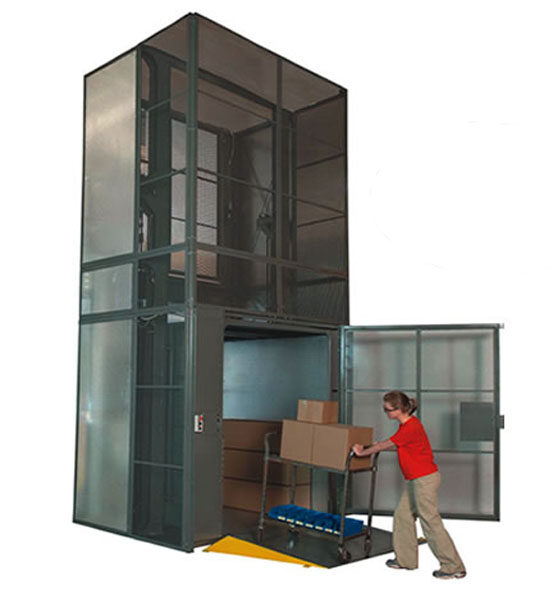
 Automated Mechanical VRC |
 Freight Elevator |
Vertical Reciprocating Conveyors (VRCs):
|
Freight Elevators:
|
The choice between a VRC and a freight elevator often depends on the facility’s specific needs, including the load types, frequency of use, safety requirements, and budget constraints. Speaking of budgets… consider the design and installation requirements for VRCs vs. freight elevators.
Three Design & Installation Considerations
 Navigating the regulatory landscape and understanding structural and installation nuances are crucial when selecting vertical transportation solutions for warehouses and distribution centers. This section delves into the key differences between Vertical Reciprocating Conveyors (VRCs) and freight elevators in terms of regulatory standards, structural requirements, and the complexity and cost of installation. Each type of lift system is governed by specific codes that influence its design, safety features, and integration within a facility. Understanding these distinctions can help facility managers make informed decisions that align with their operational needs and compliance obligations.
-
Regulatory Standards
VRCs: These are not subject to the same stringent codes and regulations governing passenger or freight elevators. In the U.S., for example, VRCs are generally regulated under the ASME B20.1 code, which covers safety standards for conveyors and related equipment. This code is less rigorous compared to those governing elevators, focusing more on material handling safety rather than passenger safety.
Freight Elevators: Must comply with stricter building codes and safety standards similar to passenger elevators. These include the ASME A17.1 code in the U.S., which covers the design, construction, installation, operation, inspection, testing, maintenance, and alteration of elevators.
-
Structural Requirements
VRCs: Typically require less extensive structural modifications to a building, as they carry loads in a more confined manner with less emphasis on ride comfort. They often have simpler mechanical designs and can be installed in existing building spaces without extensive overhauls.
Freight Elevators: Require more robust structural support due to their heavier load capacities and the need to accommodate larger dimensions. Installation might involve significant alterations to building structures to ensure stability and safety, including reinforced elevator shafts and more complex mechanical installations.
-
Installation Complexity and Cost
VRCs: Generally simpler and less costly to install compared to freight elevators. They have fewer components and do not require a traditional elevator shaft, which can significantly reduce construction costs and complexity.
Freight Elevators: Installation is typically more complex and expensive, necessitating a dedicated elevator shaft, machine room, and additional safety systems. This can lead to higher initial investment in time and money.
Whatever your vertical transport equipment needs, the Warehouse Optimizers, Inc. (WOI) expert installation team is ready to deliver excellent service. From securing the necessary permits to integrating essential systems like electrical and fire suppression, WOI ensures that every detail is carefully managed—Trust Warehouse Optimizers, Inc. to safeguard your employees, inventory, and infrastructure with precision and care.
WOI Professional Installation Advantages:
- OSHA-10 Safety Trained Project Managers
- Drug-Free Workplace Certification
- Daily Job Safety Analysis and Jobsite Inspection
- Authorized Forklift, Scissor Lift, & Aerial Lift Operators
- TN Licensed General Contractor #00046536 ($1M License)
- AL Licensed General Contractor
- Insurance Experience Mod. Rate 1.0
- Full Insurance with a $5M Umbrella
With our Total Satisfaction Experience™, you can trust that your needs will be met with precision and care throughout the project process. Your satisfaction isn’t just a goal; it’s a promise.
WOI Total Satisfaction Experience:
- We will listen to your needs
- Execute your project with particular attention to your unique application
- Stick to project timelines
- Ensure a safe environment
- Pay close attention to the details of the finished product
The WOI team is your local source throughout the Southeast, including Tennessee, Alabama, Kentucky, and North Carolina.
Contact WOI today or email info@warehouseoptimizers.com to explore how to make the most of your pallet racking systems.
Contact Us Today
We will be happy to assist you with any questions or more detailed product information on any Warehouse Optimizers products.