
Carton Flow Rack Design: 4 Factors That Affect Product Flow
Matching Your Carton Flow System to the Inventory It Handles
Carton flow rack, also called case flow rack, is a gravity flow rack system that uses inclined roller or wheeled tracks to move cartons, cases, and totes through the rack. Products are loaded from the rear and flow forward under gravity to the pick face, where they’re accessible for order picking.
The concept is straightforward. Achieving consistent product flow takes more: the system configuration has to match the inventory it handles.
Differences in carton weight, dimensions, packaging, and flow surface all affect how products move through a lane. A configuration that works well for one inventory profile may not suit another. If you’ve already determined that carton flow rack is right for your order picking operation, the next step is understanding the four design factors that influence reliable product flow—and how evaluating them upfront can help prevent problems.
Key Takeaway
Reliable carton flow starts with matching the rack design to the products being stored and the way they’ll be handled.
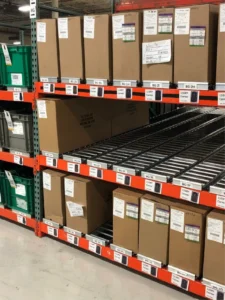
Roller Flow Rails for Same Sized Cartons
1. Product Weight and Dimensions
The physical characteristics of your inventory are the starting point for carton flow rack design. Carton dimensions and weight help determine the appropriate flow system and how it should be configured to accommodate your products.
- Account for variations in product size. Consider the range of carton, case, and tote dimensions the system will handle. Consistently sized products and inventory with varying dimensions may benefit from different carton flow configurations. Understanding the product mix helps determine the most appropriate system while making efficient use of available shelf space.
- Select equipment based on load requirements. Carton flow systems are available in standard and heavy-duty configurations to accommodate different product weights. Selecting equipment with the appropriate load capacity is an important part of matching the system to your inventory.
- Consider product height and picking access. Taller cartons and totes require sufficient vertical clearance between rack levels, including space for operators to remove products comfortably from the pick face.
2. Packaging and Bottom Surface Characteristics
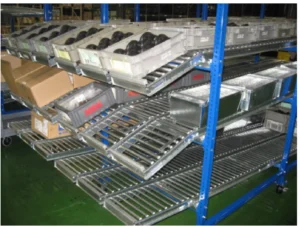
Roller Carton Flow with Angled Knuckle Shelves
Two cartons with identical dimensions and weights can behave very differently on the same flow lane. The difference is packaging, specifically the surface that actually touches the rollers or wheels.
- Material and texture. Corrugated cardboard, plastic totes, shrink-wrapped cases, and other packaging materials each interact with the flow surface differently. Friction and texture affect how easily a product starts moving and how consistently it keeps moving.
- Flat vs. irregular bottoms. Flat, rigid bottoms generally move more consistently over rollers or wheels. Uneven, recessed, or flexible bottoms may catch on flow components or conform to the flow surface, creating resistance that slows or stops product movement.
- Damaged or flexible packaging. Crushed, bowed, or soft-sided packaging can sag, catch, or jam a lane that flows fine with intact cartons.
- Catch points. Shrink wrap, seams, and straps can snag on flow components, and lipped totes can hang up on each other as they queue in the lane.
- Packaging changes. A new supplier or packaging spec can change how a SKU flows. Treat any packaging change as a reason to recheck the lane.
The actual contact surface can be just as important as the overall carton dimensions. For example, a shrink-wrapped case of bottles without a flat bottom surface may struggle to move across a wheeled flow surface. Rollers provide more continuous contact and support beneath the product, helping that same case travel more reliably through the system.
Challenging packaging doesn’t necessarily rule out carton flow. The right flow surface or accessories can often accommodate products with irregular bottom surfaces or other packaging considerations. For example, bearing rollers may provide better support and more reliable movement for certain non-flat-bottomed products, while skid plates or angle trays can help address flow challenges with lipped totes.
3. Roller or Wheeled Carton Flow Rack?
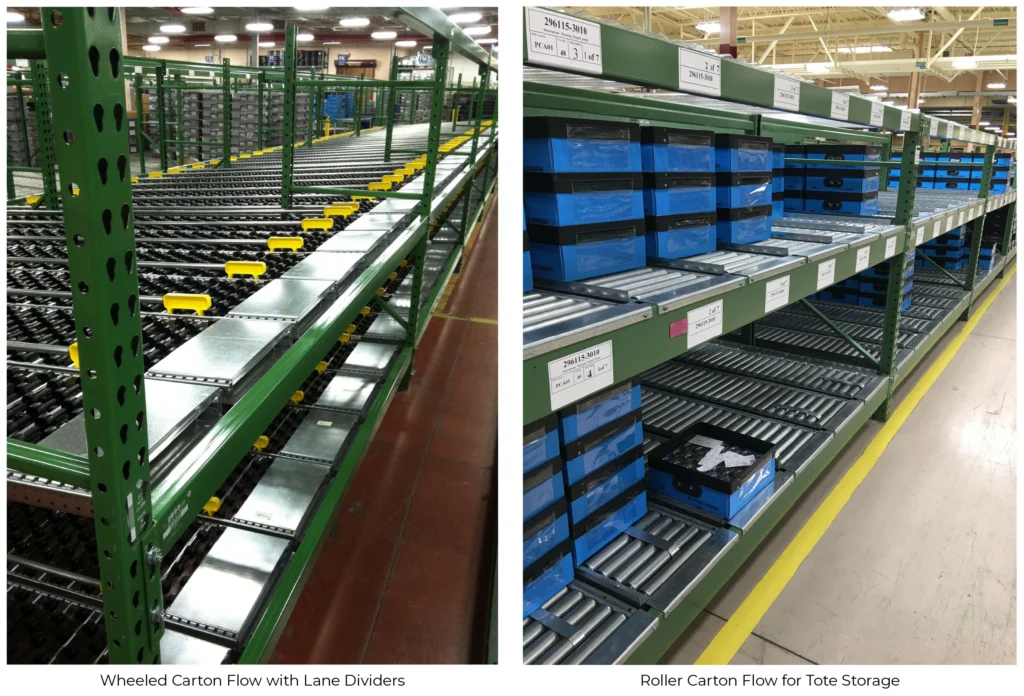
The selection and arrangement of carton flow rollers or wheels shape how cartons are supported, how consistently they travel, and how easily the system handles different product sizes. Dedicated roller tracks and full-wheel-bed systems accommodate products in fundamentally different ways.
Dedicated roller tracks use rollers typically sized to closely match the width of the product’s bottom surface. That makes them well suited to consistent carton sizes. The limitation shows up with oversized products. A carton that extends beyond the roller width can contact the outside rails of the track and get hung up.
Full-wheel-bed systems use closely spaced wheel tracks to create a nearly continuous flow surface across the shelf. Cartons of varying widths can be positioned more freely, side by side, provided their bottom surfaces get sufficient contact and support.
| Dedicated Roller Tracks | Full-Wheel-Bed Systems | |
|---|---|---|
| Best fit | Consistent carton or tote widths (often the more economical option) | Varying carton widths and frequently changing SKU profiles |
| How products ride | On rollers matched to the bottom surface | On a nearly continuous field of wheels |
| Width flexibility | Limited to the roller width | SKU lanes sized to the inventory |
| When SKUs change | A new carton width may need a different-sized rail | Lanes are easily re-profiled as inventory changes |
| Watch for | Oversized cartons catching on track rails | Soft or irregular bottoms that can catch on wheels and interrupt flow. |
An operation handling consistently sized cartons may be a good fit for dedicated roller tracks. A warehouse handling a wider variety of carton sizes or frequently changing SKU profiles may benefit from the flexibility of a full-wheel-bed system. Either way, packaging and bottom surfaces still matter.
4. Lane Pitch and Flow Speed
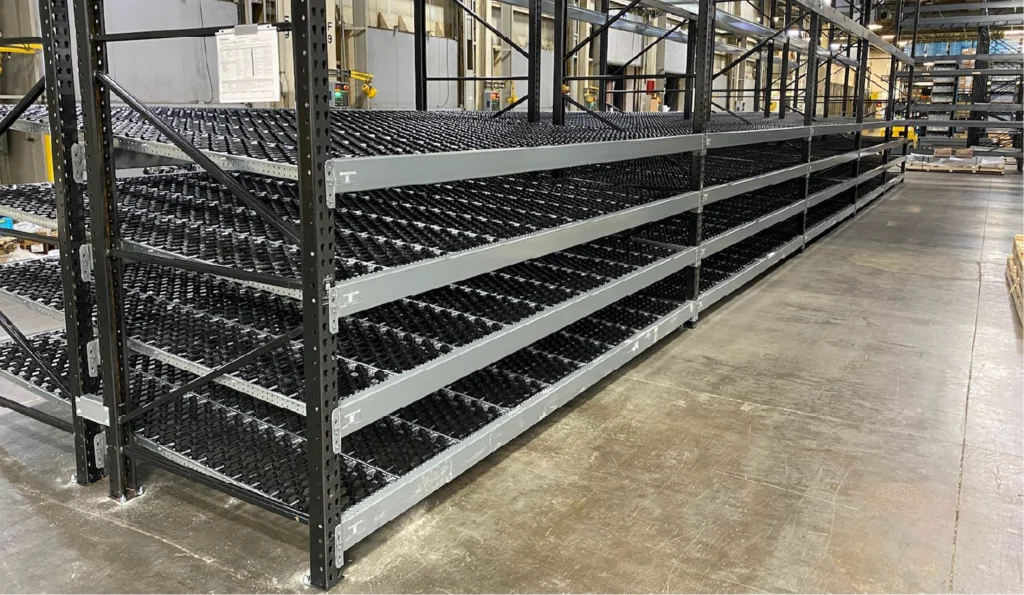
Wheeled Carton Flow Rack Shelving for Case and Each Picking
Carton flow relies on gravity to move products through the rack, but the lane pitch must be properly set to maintain consistent, controlled movement. Pitch refers to the slope of the lane from the loading side to the pick face, typically expressed as inches of drop per foot of lane depth.
- Too little pitch can leave cartons stalled before they reach the pick face, forcing pickers to reach in after them.
- Too much pitch can cause products to move too quickly, strike the pick face hard, or become unstable, especially with tall cartons.
- Weight and packaging change the equation. Product weight and packaging friction both affect how much incline a carton needs to start and keep moving.
- The flow surface matters. Roller and wheel designs don’t all resist movement equally, so the same carton may need a different pitch on a different configuration. A lower-resistance flow surface may allow for a shallower pitch, which can also help preserve vertical space within the rack.
- Lane depth and orientation count. In a deeper lane, the same pitch adds up to a bigger drop from load end to pick face, and the spacing between shelves has to accommodate it. Orientation decides which carton dimension travels down the lane, which can change how the carton rides.
Increasing the incline isn’t always the right answer to a carton that won’t flow. Packaging friction, product orientation, and the interaction between the bottom surface and rollers or wheels can all affect movement. In one real-world example, a carton positioned sideways on a wheel-bed system struggled to flow. Simply rotating it 90 degrees, so its longer dimension traveled down the lane, reduced friction and allowed it to flow smoothly without changing the pitch.
Get Carton Flow Rack Design Right With WOI
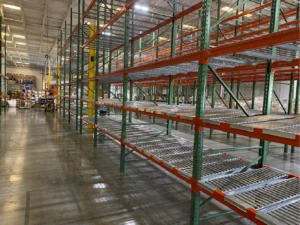
Roller Carton Flow Tracks Beneath Full Pallet Storage
Successful carton flow rack design depends on how well the system accommodates the products it will handle. The four factors don’t work in isolation:
- Weight and dimensions help determine the appropriate carton flow equipment, system configuration, and vertical clearance requirements.
- Packaging determines what actually touches the flow surface.
- The roller or wheel configuration determines how products are supported and how easily the system adapts to new SKUs.
- Pitch ties it all together, and it’s only right when it’s set for the real product on the real flow surface.
We understand that successful carton flow rack design starts with the inventory. Our team evaluates your product characteristics, storage requirements, and picking operations to recommend a carton flow configuration suited to your application. From standard carton flow to heavy-duty systems, WOI can help you select and implement a solution designed to keep products moving reliably.
Established in 1998, WOI supports you from system design through installation. And because carton flow often works alongside pallet rack, pick modules, and conveyor, our team designs your carton flow racking to fit the larger warehouse operation.
WOI Professional Installation
With over 300 installations completed annually, our experienced team handles everything from permitting to final sign-offs, ensuring seamless project execution.
WOI Professional Installation:
- OSHA-10 Trained Project Managers
- Drug-Free Workplace Certification
- Daily Job Safety Analysis and Jobsite Inspection
- Authorized and Trained Forklift, Scissor Lift, and Aerial Lift Operators
- TN & AL Licensed General Contractor #00046536 ($1M License)
- Insurance Experience Mod. Rate 1.0
- Full Insurance with a $5M Umbrella
Trust WOI to get your next pallet rack installation done right.
The WOI Total Satisfaction Experience™
When you partner with WOI, you gain more than just design and installation expertise. You receive a dedicated team committed to your success. Our WOI Total Satisfaction Experience™ is built around five key principles:
- Listening to Your Needs – We take the time to understand your unique challenges and requirements.
- Executing with Precision – Our expert team ensures that your system is tailored to your exact specifications.
- Adhering to Timelines – We respect project deadlines to minimize disruptions and maximize efficiency.
- Ensuring Safety – Every aspect of our work prioritizes safety for your employees and operations.
- Attention to Detail – We meticulously oversee every phase of the project to deliver a flawless installation.
Improve warehouse efficiency and safety with WOI’s comprehensive gravity flow solutions and expert installation services. Contact us today to discuss your next project!
WOI Service Areas
Nashville TN, Knoxville TN, Clarksville TN, Memphis TN, Chattanooga TN, Johnson City TN, Huntsville AL, Birmingham AL, Bowling Green KY, Asheville NC, Charlotte NC, South Bend IN
Contact Us Today
We will be happy to assist you with any questions or more detailed product information on any Warehouse Optimizers products.