
Stick-Built vs. Modular Warehouse Construction for In-Plant Buildings
Comparing Cost, Speed, and Flexibility for In-Plant Spaces
Warehouse operations evolve. Teams grow, production lines expand, and facilities suddenly need more space while worrying about the workflow disruption. When that happens, facility managers typically have two options: traditional stick-built construction or modular construction.
Both approaches can create functional interior spaces. But when comparing stick-built vs. modular construction, they differ significantly in installation time, operational impact, flexibility, and long-term value. We’ll help you understand the differences and aid you in determining which solution best fits your facility.
Key Takeaway
For most interior warehouse offices and personnel spaces, modular construction provides faster installation, less disruption, and greater flexibility. Stick-built may still make sense for highly customized or permanent architectural projects, but modular is often the preferred solution inside active industrial facilities.
What Is the Difference Between Stick-Built and Modular Construction?
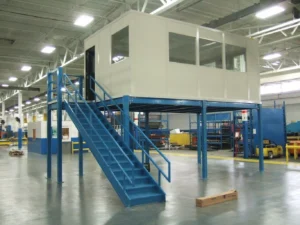
Stick-built construction is built entirely on-site. Multiple trades (framing, drywall, electrical, HVAC) work in sequence, one after the other, inside your facility.
Modular construction flips that model. Components are manufactured in a factory, delivered to your facility, and professionally assembled on-site. WOI’s modular buildings and prefab offices are industrial modular buildings designed specifically for warehouse and manufacturing environments.
Common applications for warehouse modular buildings include:
- Warehouse offices and security offices
- Cleanrooms and quality labs
- Break rooms and conference rooms
- Equipment and electrical rooms
- Personnel spaces of all kinds
Stick-Built vs. Modular Construction at a Glance
| Factor | Modular | Stick-Built |
|---|---|---|
| Installation Speed | ✔ Faster installation | Longer construction schedule |
| Operational Disruption | ✔ Minimal | Greater impact on operations |
| Cleanliness | ✔ Less dust and debris | More on-site construction |
| Business Downtime | ✔ Often remains operational | May require larger work zones |
| Future Expansion | ✔ Easy to expand or relocate | Renovation typically required |
| Construction Quality | ✔ Factory-controlled manufacturing | Depends on field construction |
| Customization | Excellent for most warehouse applications | Best for highly specialized designs |
| Cost | Often lowers total project cost | Depends on labor, schedule, and site conditions |
| Permitting | Building codes still apply | Building codes still apply |
Why Modular Construction Is Often the Better Choice for Warehouses
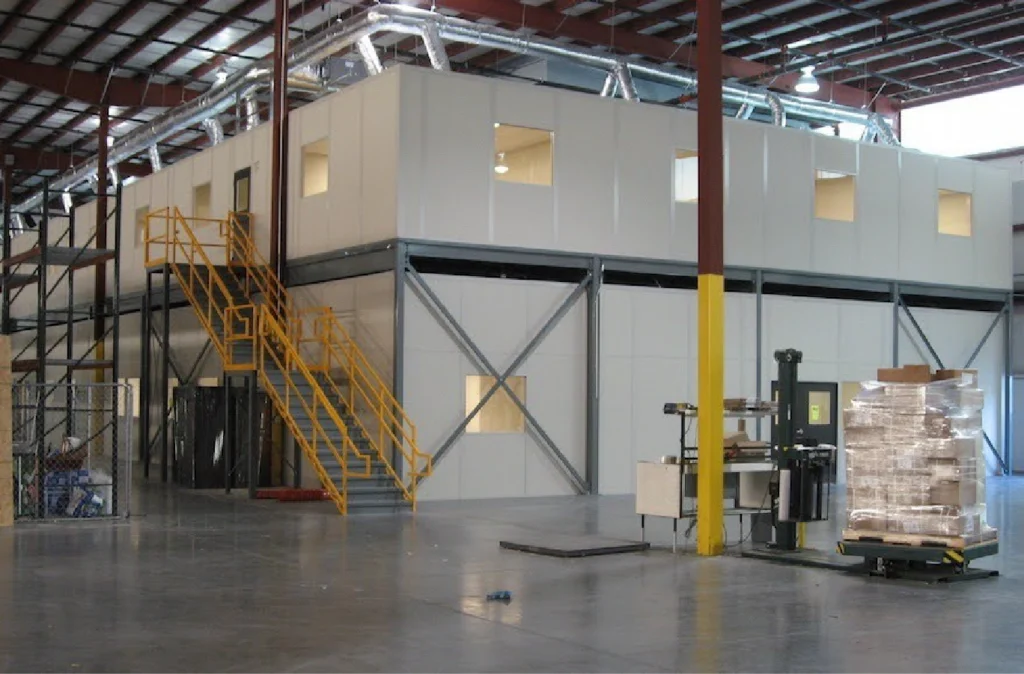
Faster Installation
With modular, manufacturing and site prep happen at the same time. While panels and components are being built at the factory, your floor is being prepped for install. Nothing waits in line.
That concurrency compresses project timelines noticeably. Modular offices can often be customized and installed in as little as 2–4 weeks, compared to 8–12 weeks or more for a comparable stick-built space.
For the fastest option, preassembled modular buildings arrive fully built on a forkliftable base. Personnel set it in place, connect the power, and go.
Less Disruption to Daily Operations
This is one of the biggest advantages of modular buildings inside an active facility:
- Less dust migrating into product and equipment
- Less noise on the floor
- Less contractor traffic through your operation
- Smaller, contained work areas
- Employees keep working while the space goes up
Shipping keeps shipping. Production keeps producing.
Cleaner Installation
Cleanliness is often the deciding factor for facilities handling food, pharmaceuticals, electronics, or open production.
Modular panels arrive finished. There’s minimal on-site cutting, sanding, mudding, or painting. It means far less airborne dust and debris around your inventory and equipment. Crews stage components, assemble them, and clean up a compact footprint. Compare that to weeks of saws, drywall dust, and paint fumes drifting across the floor.
Easier to Expand, Relocate, or Reconfigure
Modular changes as the space changes. Panels are demountable. A modular office can be expanded, reconfigured, or moved to a new spot in the building (or a new building entirely) without demolition.
If growth is on the horizon, planning a scalable modular office from day one protects the investment. A stick-built wall, by contrast, comes down with a sledgehammer and goes in a dumpster.
Consistent Factory Quality
Modular components are manufactured in a controlled environment with repeatable processes, jigs, and quality checks. That’s not necessarily “better” than skilled field work, but just more consistent.
Every panel, every joint, every finish arrives to spec, regardless of weather, scheduling pressure, or which crew showed up that day.
Does Modular Construction Cost Less?
There are really two costs to compare.
Building Cost
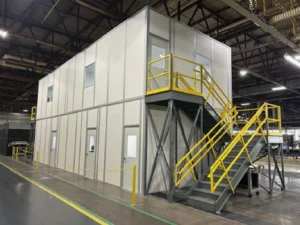
Compare two buildings with the same spec, and the shell cost can land in a similar range, no matter which method you choose. That’s because the price is, in fact, driven more by what’s inside the walls.
Here’s what actually moves the number:
- Square footage and interior ceiling height
- Wall type and insulation level
- HVAC, electrical, and data/telecom packages
- Doors, windows, and access control hardware
- Interior finish level (basic paint-grade vs. upgraded finishes)
- Fire-rating, sound control, or code requirements tied to the use case
Spec two buildings the same way, and the sticker price on the structure itself often ends up close. The real separation between modular and stick-built shows up once the project actually starts moving.
Total Project Cost
This is where modular frequently saves money, and it’s a core part of the 6 key advantages of modular construction we listed earlier:
- Lower installation labor (assembly, not sequential construction)
- Faster occupancy: the space starts earning its keep in weeks, not months
- Reduced operational disruption during the build
- Less downtime for surrounding operations
- Future reconfiguration instead of demolish-and-rebuild
- Possible tax advantages depending on the project
Tax treatment varies by ownership structure and how the building is classified, and should be reviewed with your accounting professional.
When Does Stick-Built Construction Make Sense?
To be fair, modular isn’t the answer for everything. Stick-built construction is typically the better fit for:
- Highly customized architecture with unique finishes or forms
- Permanent structural additions to the building itself
- Irregular layouts that don’t suit panelized systems
- Projects integrated into a major building renovation already underway
If your project falls into one of those categories, traditional construction may serve you better.
When Should You Choose Modular Construction?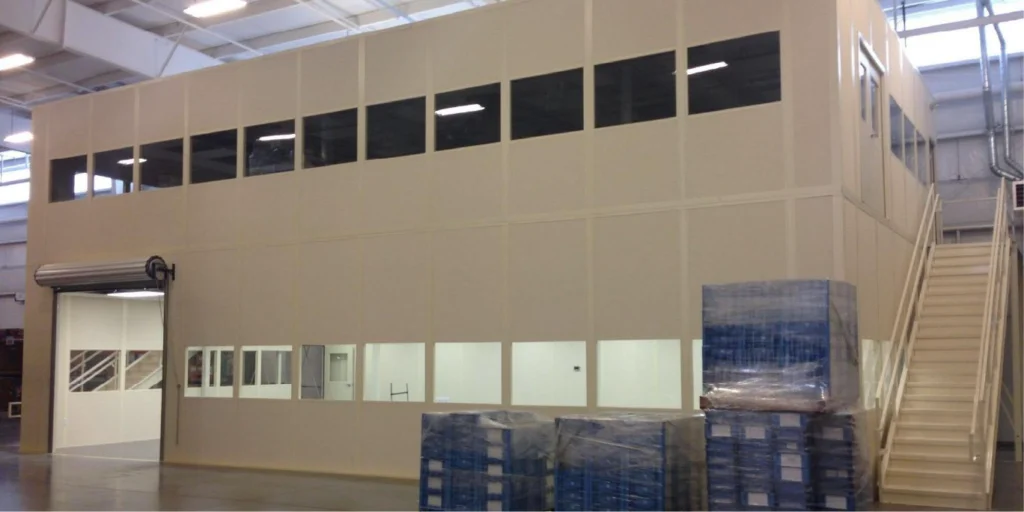
For dedicated spaces inside an active warehouse or plant, modular is usually the stronger play. Think:
- Warehouse offices and multi-story in-plant offices
- Break rooms and training rooms
- Cleanrooms and QA labs
- Security offices
- Equipment rooms and electrical rooms
- Personnel areas of every kind
That’s how facilities handle transitions. See how a modular building renovation case study kept a Tennessee auto plant moving during a major renovation, and how teams are using modular offices during a relocation or renovation to bridge transitions without losing productivity.
The Value of Professional Project Planning
Whichever method you choose, planning determines whether the project goes smoothly. A complete plan covers:
- Space planning: footprint, sightlines, workflow, and headcount
- Utilities: electrical, data, and plumbing routed cleanly from day one
- Fire protection: sprinklers, egress, and fire-rating requirements
- HVAC: sized for occupancy and equipment heat load
- Building codes and permitting: addressed early to support efficient installation
- Future growth: second levels, expansions, and relocations planned before the first panel is set
Our modular office planning checklist walks through the exact questions we ask before every project. Our guide to warehouse project timelines and permitting covers what to expect from approval through final sign-off.
Frequently Asked Questions
How long does modular construction take?
Weeks, not months. Many modular offices are delivered and installed in 2–4 weeks, with manufacturing and site prep running concurrently.
Are modular warehouse offices permanent?
They can be. Modular offices are built for long-term use—the difference is they don’t have to be permanent. They can be demounted and reused if your facility changes.
Can modular offices be relocated?
Yes. Panelized systems can be disassembled and reinstalled elsewhere, and preassembled buildings on forkliftable bases can simply be picked up and moved.
Do modular buildings require permits?
Building codes still apply, and permitting requirements vary by location and scope. WOI coordinates permitting and inspections as part of a turnkey project.
Can modular offices include HVAC, plumbing, and electrical?
Yes. Modular buildings can be outfitted with HVAC, electrical, data/telecom, plumbing, flooring, soundproofing, and more.
Are modular offices code-compliant?
Yes—when designed and installed correctly. WOI designs and installs modular spaces to meet applicable building, fire, and egress codes for your jurisdiction and application.
Choose the Right Construction Approach for Your Facility
For most warehouse and manufacturing applications, modular construction offers a practical combination of speed, flexibility, installation cleanliness, and minimal operational disruption. Stick-built construction may still be appropriate for highly specialized or structurally complex projects.
Warehouse Optimizers Inc (WOI) provides design and layout support for modular offices, in-plant rooms, personnel spaces, and specialized facility enclosures. Our team coordinates permitting, utilities, installation, inspections, and final sign-off to keep the project moving from initial planning through completion. Safely, accurately, and with as little disruption to ongoing operations as possible.
The WOI Total Satisfaction Experience™
At Warehouse Optimizers, Inc. (WOI), safety is our top priority. With over 300 professional installations completed annually, our experienced team handles everything from permitting to final sign-offs. Every project is backed by the WOI Total Satisfaction Experience™, built around five key principles:
- Listening to Your Needs: Understanding how the space will be used, what the project must accomplish, and how it will affect your operation.
- Executing with Precision: Coordinating the layout, materials, utilities, and installation details required for a complete modular building solution.
- Adhering to Timelines: Planning and managing the work to support your schedule and reduce delays.
- Ensuring Safety: Following established safety procedures while working within active industrial environments.
- Attention to Detail: Verifying finishes, connections, system components, and final project requirements before sign-off.
Not sure whether modular or stick-built construction is the right fit for your project? Warehouse Optimizers can review your space, application, schedule, and long-term plans to help you evaluate your options.
Prefer to talk it through? Call 865-540-4004 or contact our team.
WOI Service Areas
Nashville TN, Knoxville TN, Clarksville TN, Memphis TN, Chattanooga TN, Johnson City TN, Huntsville AL, Birmingham AL, Bowling Green KY, Asheville NC, Charlotte NC, Kalamazoo MI, South Bend IN
Contact Us Today
We will be happy to assist you with any questions or more detailed product information on any Warehouse Optimizers products.