
Roll-Out Racks: Safer Access, Faster Retrieval, Better Use of Space
A Practical Guide to Roll-Out Racking for Sheet, Long Stock, and Pallet Loads
Running a manufacturing facility is no small job—and keeping your team safe is always a top priority. If you’re looking for a storage solution that can streamline daily handling and reduce risk on the floor, roll-out racking is worth a closer look.
Roll-out racks are designed for the realities of manufacturing. They store heavy sheet goods, bar stock, and awkward pallet loads in high-capacity vertical space—so you can move away from floor stacking and the workarounds that come with it. No more weaving around piles, climbing onto pallets to reach the right sheet, or shifting multiple bundles of long stock just to access the one you need. Those extra steps slow production and can introduce avoidable safety concerns.
Roll-out systems work differently by bringing the load out to the operator instead of forcing employees to reach deep into tight storage positions. When used correctly, they can speed up retrieval, reduce rehandling, and help you get more value from the space you already have.
What is a roll-out rack?
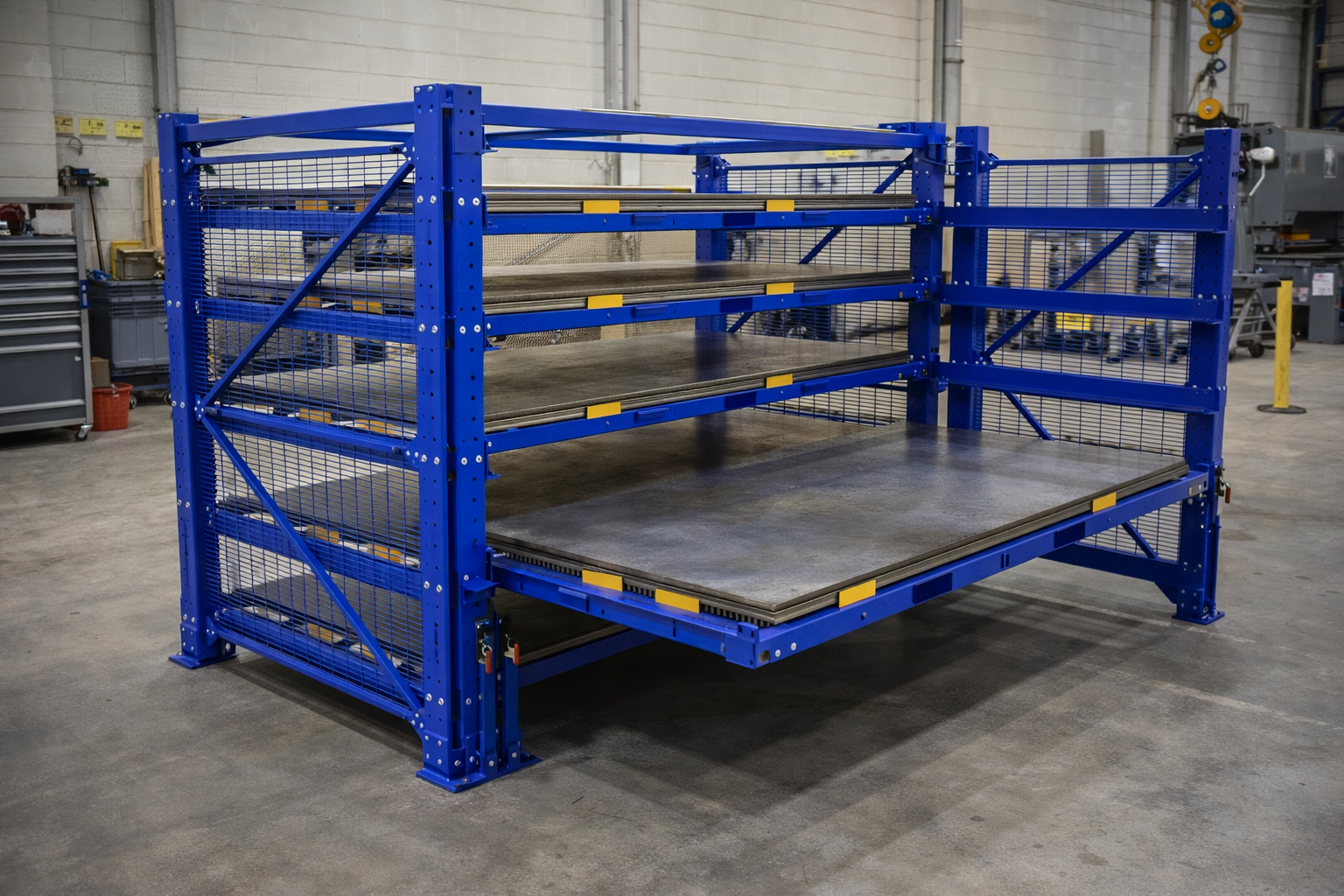
A roll-out rack is a storage system featuring drawers, shelves, cartridges, or arms that slide or crank out of the frame, allowing the stored material to be fully accessible.
Instead of static beams, the storage levels are mounted on rollers or guided mechanisms. Many designs extend 75% to 100% of their depth, making the material accessible to an overhead crane, jib crane, vacuum lifter, or forklift for easy picking.
Some systems handle pallet loads. Others are purpose-built for flat sheet, partial remnants, or long bar and tube. What they have in common is the idea that you should be able to see and reach what you need without climbing into a bay or unstacking piles by hand.
Core Benefits Of Roll-Out Racks For Sheet, Long Stock, And Pallets

When you use roll-out racks for the right inventory, they offer several practical advantages.
Better accessibility and selectivity
Roll-out shelves and drawers give operators direct, front-facing access to the load. For sheet metal, drawers that extend out of the frame provide access to any bundle, vs. simply the one on top.
For long bar stock, crane-friendly roll-out cantilever receptacles allow you to select specific sizes without having to dig through a bundle. The result is true selectivity. You see exactly what is stored in each position and can go straight to the item you need.
Less handling and fewer “repositions”
Because the load comes to the aisle, you reduce the number of times operators have to shuffle material out of the way. Roll-out pallet shelves, for example, allow a pallet stored in the back of a bay to be pulled forward rather than forcing someone to reach over or move the front pallet first.
Less rehandling means less product damage and fewer chances for pinch points, dropped pieces, or strained backs.
Space efficiency in the right applications
Roll-out racks are often paired with overhead cranes or jib cranes. That combination can allow tighter storage layouts, because you do not need wide drive aisles for forklifts between every row. Long material or sheet stock can be stored in dense banks of drawers that open into a shared handling zone.
You are using cubic space to its fullest instead of spreading material across the floor in low, hard-to-reach piles.
Cleaner organization and easier inventory checks
With each SKU in its own labeled drawer, cartridge, or cell, inventory checks become a quick visual scan instead of a guessing game. Honeycomb racks for bar stock, for instance, divide material into dedicated slots that make it easy to see what sizes are running low.
That clarity helps production planners and buyers keep the right material on hand without overstocking “just in case.”
6 Roll-Out Rack Types to Meet Your Stock Needs

There is no one “roll-out rack.” WOI helps match different designs to specific materials and workflows.
1. Roll-out pallet storage and pull-out shelves
Roll-out pallet shelves mount to rack beams or the floor and slide forward so operators or an overhead crane can access loads, typically up to 3,000 pounds per shelf. They are ideal near presses, molding machines, and assembly cells where you need fast access to heavy fixtures or pallets without sending workers into deep rack bays.
2. Roll-out sheet racks for flat stock
Horizontal roll-out sheet racks stack flat sheets or plates in heavy-duty drawers, with many models rated at around 5,000 pounds per shelf and some models rated as high as 10,000 pounds. Drawers pull out fully, allowing an overhead crane or vacuum lifter to grab a single bundle for laser, plasma, waterjet, or fabrication work without cluttering the floor around the machines.
3. Vertical sheet metal storage roll-out racks
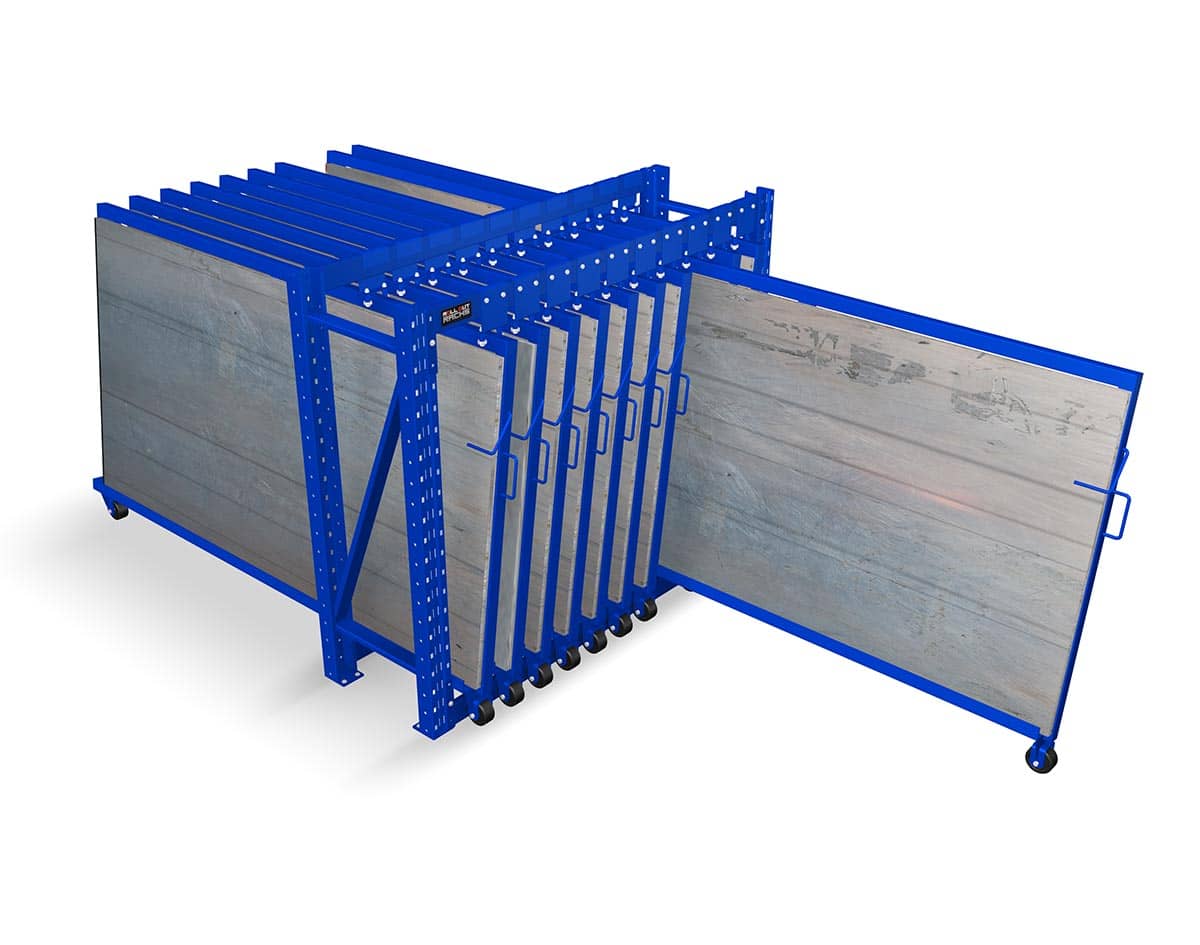 Vertical roll-out sheet racks store cut pieces, partial sheets, and remnants in tall, narrow drawers that slide out of the frame, typically holding 1,500 to 2,000 pounds each.
Vertical roll-out racks shine in high-mix environments, letting operators see each sheet edge, pull out a drawer, and select the right item without digging through stacks or bending material.
4. Sheet towers with forklift-friendly cartridges
Sheet tower systems stack multiple horizontal cartridges in a vertical tower. Each cartridge is designed to handle around 5,000 pounds and can be pulled out or removed with a forklift. Towers are often used as buffer storage between steel delivery and cutting operations. They provide dense storage in a small footprint while keeping every cartridge accessible for staging.
5. Honeycomb racks for tube, bar, and angle
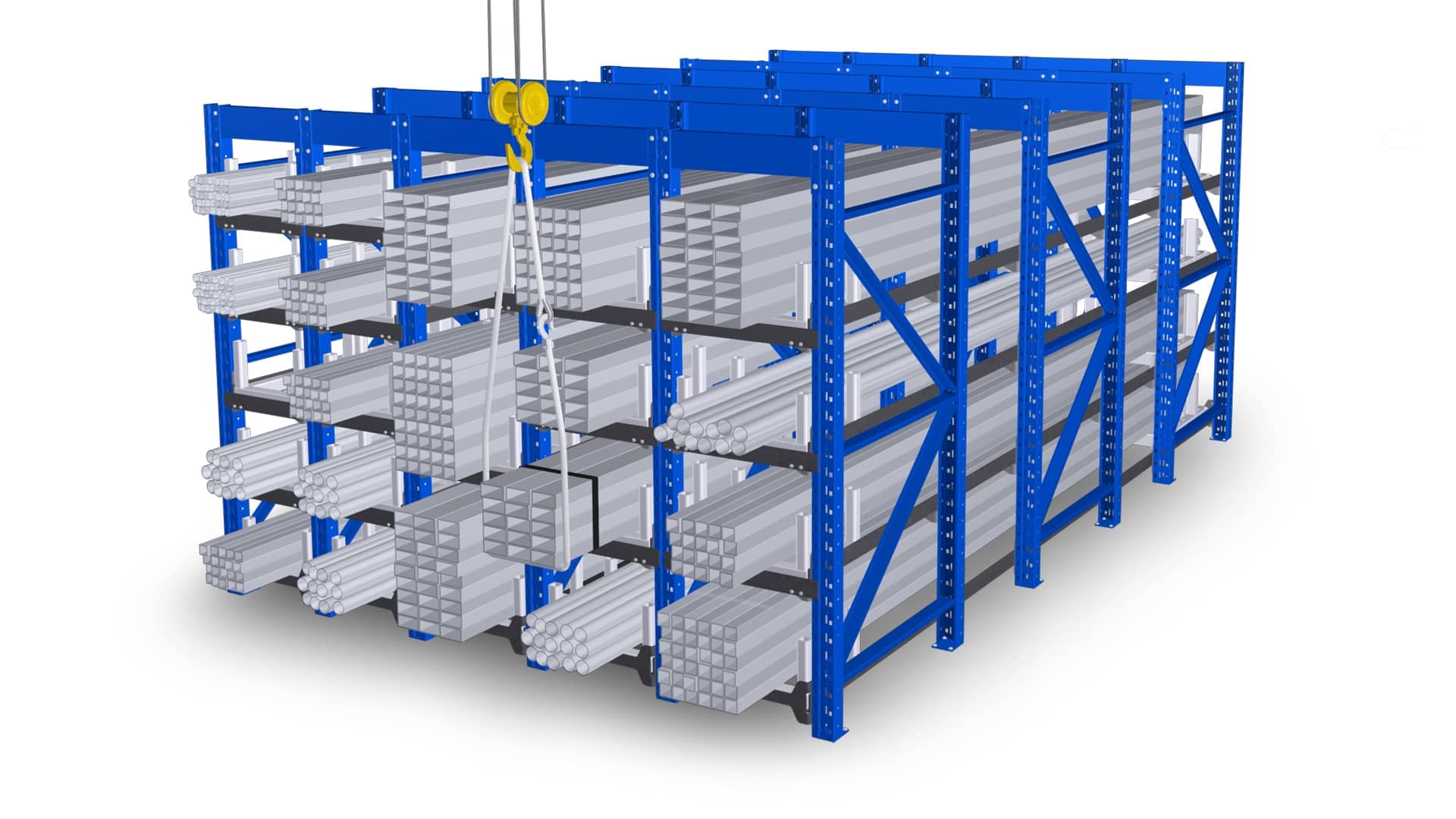
Honeycomb racks create a grid of cells sized for tubes, bars, angles, and other long products, with material stored in individual front-access slots or pull-out cassettes. Each size and shape gets its own spot, which prevents tangled nests of stock when you need to remove a single bar.
6. Roll-out cantilever racks for crane-served long stock
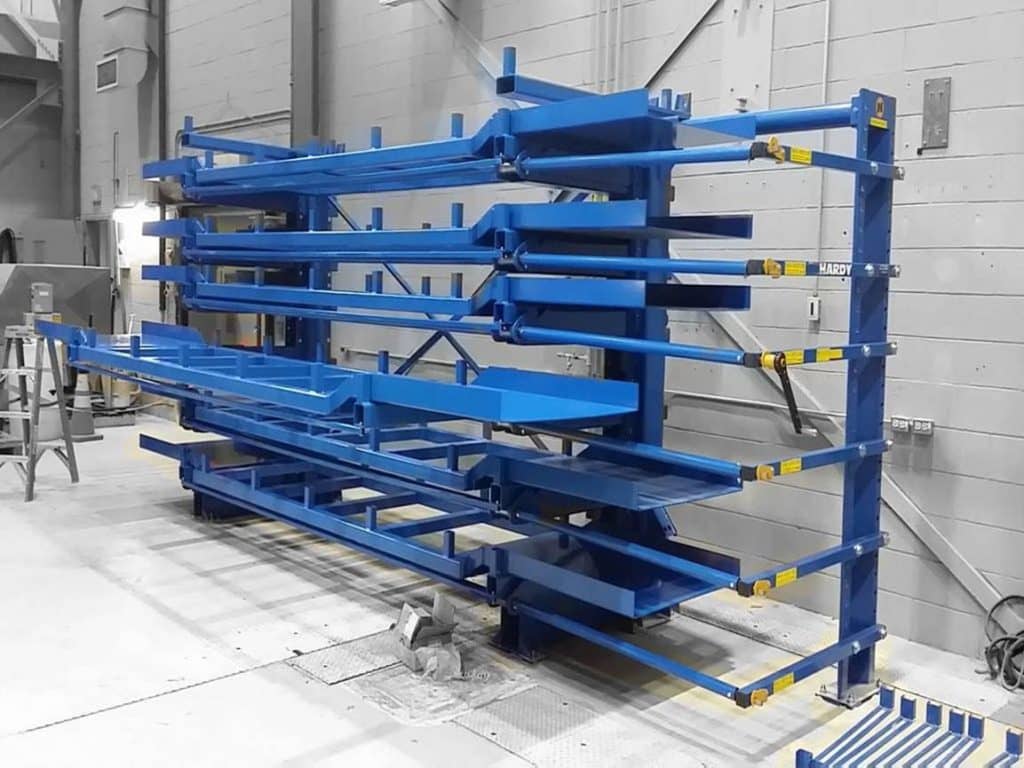
Roll-out cantilever racks combine open cantilever arms with roll-out or crank-out movement so arms or receptacles extend clear of the frame for easy crane access. They are ideal for steel service centers, structural fabrication, and any operation storing long profiles on floor stands or hard-to-reach static cantilevers.
 |
 |
| Honeycomb Rack |
Cantilever Rack |
Where Roll-Out Racks Tend To Fit Best
Most roll-out systems are deployed where the material is heavy, the mix is high, and changeovers occur frequently. Typical applications include:
- Metal fabrication and laser cutting cells storing raw sheet and drops
- Machine shops handling plate, mold bases, and tooling plates
- OEM and contract manufacturers storing long profiles, tube, and angle
- Maintenance and tooling areas with heavy fixtures or dies near production lines
- Distribution centers that handle awkward sizing, such as doors, windows, or long cartons
Match Your Roll-Out Solution to Your Operational Needs
The WOI team has the expertise to help you select the roll-out rack solution that best suits your operation, goals, and available space.
Here are the key criteria used in specifying your system.
✔️ Load ratings and product dimensions:
Confirm drawer, arm, or cartridge capacity for your heaviest load and match shelf or cell size to sheet size, bundle height, and bar length.
✔️ Floor slab capacity and anchoring:
Have a qualified professional verify slab thickness and reinforcement, then anchor the system according to manufacturer specs and local code.
✔️ Equipment interface:
Check clearances for overhead cranes, jib cranes, vacuum lifters, or forklifts so drawers can extend fully and loads can be lifted cleanly.
✔️ Safety controls and training:
Use systems with mechanical stops and controlled drawer openings, and train operators on correct loading, extension limits, and signs of damage.
✔️ Labeling and inventory practices:
Assign clear locations and labels so drawer or cell numbering aligns with your ERP or WMS for accurate counts and fast picking.
WOI Installation, The Total Satisfaction Experience, And Next Steps
WOI installation services cover layout verification, anchoring, and coordination with crane paths, building columns, and existing pallet racks.
Crews are trained in safe work practices and are used to working around live operations, so that you can stay productive while the new equipment is installed.
The WOI Total Satisfaction ExperienceTM is built around five principles:
- Listening to your needs
The team spends time on your floor to understand which materials are causing bottlenecks, where operators struggle, and how your cranes and forklifts actually move. - Executing with precision
Designs are tailored to your sheet sizes, bar lengths, load weights, and space constraints, then installed according to manufacturer specifications and local codes. - Adhering to timelines
Installation is coordinated with production schedules, ensuring changeovers, cutovers, and tie-ins are handled with minimal disruption. - Ensuring safety
Every phase, from unloading the new rack to final signoff, emphasizes safe practices for your employees and the WOI crew. - Attention to detail
From shim stacks under base plates to drawer travel checks and labeling, WOI works through a punch list that leaves you with a system ready to go live day one.
We service our customers in Nashville, Knoxville, Clarksville, Memphis, Chattanooga, Johnson City, Huntsville, Birmingham, Bowling Green, Asheville, Charlotte, Kalamazoo, South Bend, and surrounding regions.
Contact Us Today
We will be happy to assist you with any questions or more detailed product information on any Warehouse Optimizers products.